
ATLANTA – “I wish we didn’t ship out nearly 80,000,000 pounds of food last year.”
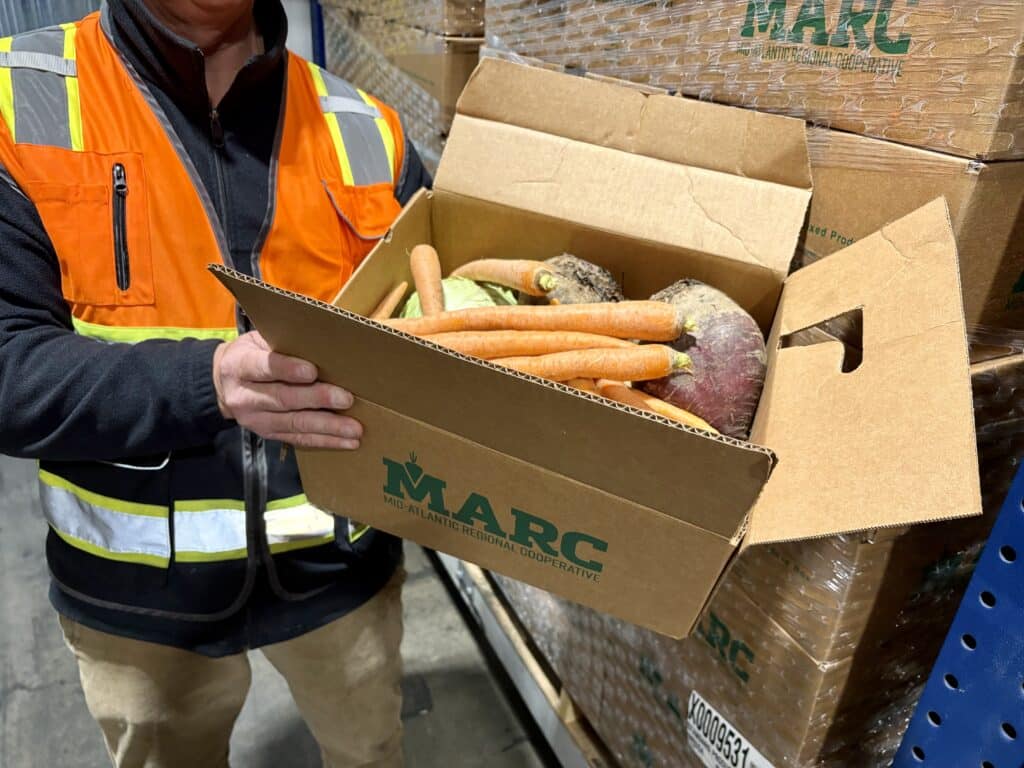
As director of operations for the Philadelphia-based Mid-Atlantic Regional Cooperative (MARC), John Sciortino is acutely aware of how much food goes uneaten in the United States, and how much of that food could be making it into the hands of families experiencing food insecurity.
But Sciortino is proud of how much surplus food the MARC is able to rescue from farmers, wholesalers, and retailers and then package and redistribute to local food banks.
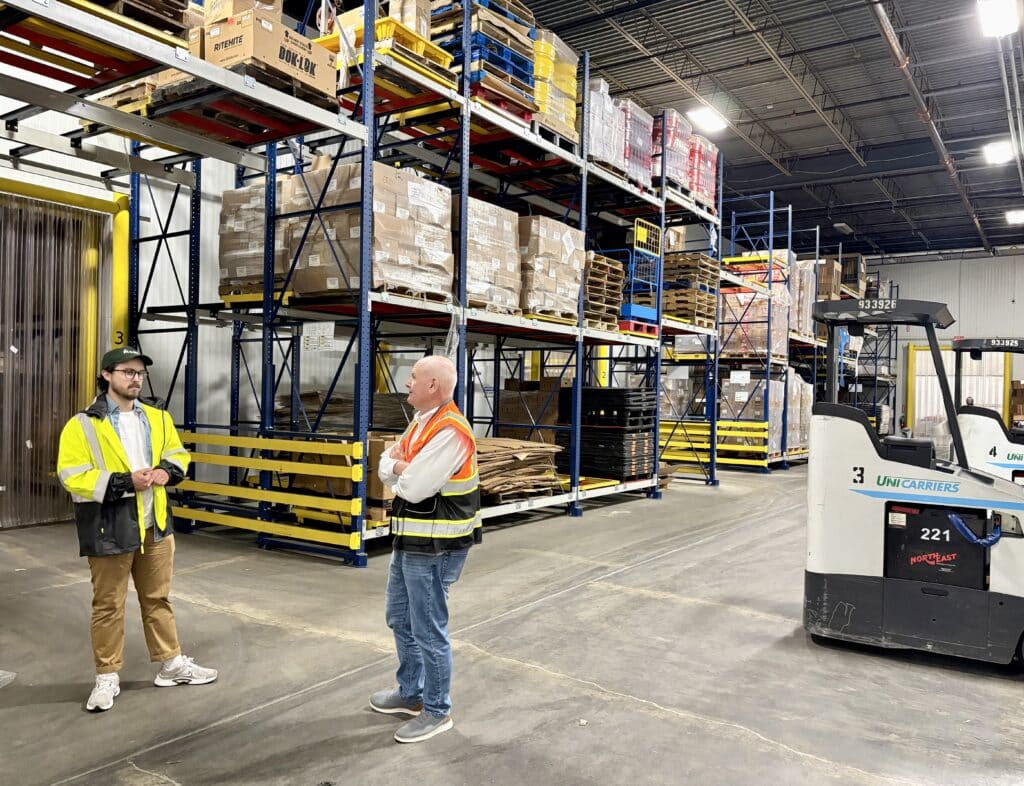
Operating out of a 60,000 square-foot warehouse, the MARC and its network move more than 1 million pounds of food each week. And not only shelf-stable, dry goods. The majority of the food they absorb and deliver is fresh, seasonal produce.
“The goal is simple: we help food banks say ‘yes’ to more nutritious food while getting that food to neighbors faster and more consistently,” says Sciortino.
A Big Network, an Even Bigger Need
The MARC is one of Feeding America’s 11 regional co-ops. In the Northeast, the MARC’s reach includes 30 partner food banks across 13 states.
As the nation’s largest hunger relief organization, Feeding America® support tens of millions of people as part of a nationwide network of 250+ food banks, 20+ statewide food bank associations and 60,000+ agency partners, food pantries, and meal programs. Their network spans all 50 states, connecting billions of pounds of food to families facing hunger.
Even with this vast network in place, the need for increased access to nutritious food is only growing. Recent changes to federal nutrition programs, including SNAP, are occurring alongside high food and living costs and broader economic pressures.
Feeding America sees the need for a stronger, more connected food system so that access to nutritious food is possible for every community.
“Partnerships are essential to support Feeding America in addressing today’s food and hunger challenges,” says Lindsey Moorman, director of Foundation Relations at Feeding America. “Hunger is a complex issue that will take all of us working together. Meaningful progress requires collective action.”
Working in Partnership, Building Capacity
In late 2025, The United Methodist Church’s General Board of Global Ministries granted $500,000 to Feeding America in support of their regional food sourcing and sharing initiatives, with a shared goal to capture more available food and distribute it where it is needed most.
“We were compelled to respond to hunger in the U.S. as a result of conversations we had within the communities we serve. Time and time again, we continued to hear about food insecurity,” says Jim Cox, who leads humanitarian relief and recovery for Global Ministries. “With its well-established network, Feeding America was a natural partner to help end hunger on a large scale. We also responded by launching a grant program that supported 150 food pantries within local UMC churches, Feeding Our Neighbors.”
With funds from Global Ministries, the MARC and other Feeding America co-ops in regions like the Pacific Northwest and Desert Southwest have been actively scaling up their capacities to both procure greater varieties and deliver higher volumes of food.
“This grant opportunity enabled us to assist small and medium-sized food banks in alleviating some of their sourcing and storage challenges, as well as create savings by leveraging our logistical expertise and volume capabilities,” says Beth Hamilton, the MARC’s executive director. “We can support them with sourcing not only an abundance of fresh produce, but also a continued supply of refrigerated dairy items and frozen protein, working locally and regionally to source many of those items.”
Responding to Needs with Creative Solutions
Just 30 minutes north of their warehouse, one of the MARC’s member food banks in New Jersey serves 300 emergency feeding programs.
The Food Bank of South Jersey (FBSJ) supports partner agencies that deliver millions of meals each year. The food that flows through their facility is a combination of purchased, donated, and TEFAP (USDA’s Emergency Food Assistance Program).
“Neighbors having access to fresh healthy foods is tremendously important but also logistically complex. Partnerships, both local and into the Feeding America network, are critical for supporting the creative solutions to move volumes of perishable foods to those who need them most,” says Ashley Mcpherson, senior director of Supply Chain for FBSJ.
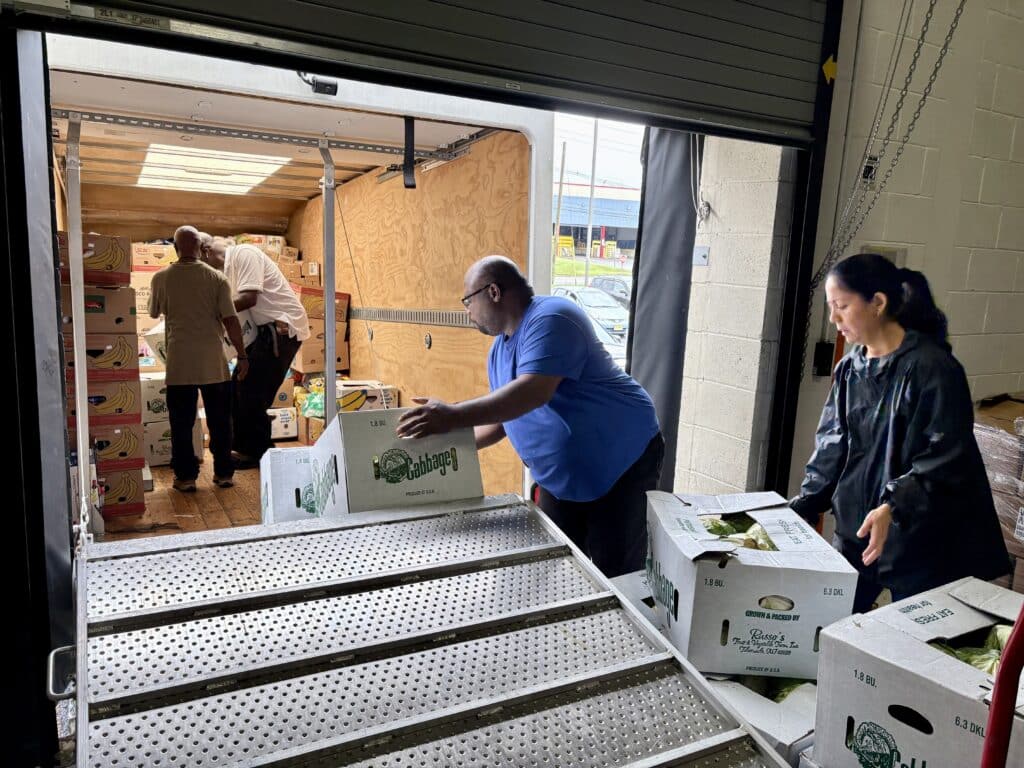
The food bank helps its partner agencies obtain food through its online ordering system, including access to an ever-rotating inventory of fresh foods. Many of these come from the MARC.
Fruits, vegetables, protein, and dairy are consistently the most requested foods from neighbors, and FBSJ’s on-site cold storage system allows them to receive and distribute perishable foods that require refrigeration. They are also in the process of adding a repack room (or “clean room”) to their facility, giving them the opportunity to break down and repackage bulk food into individual or family-sized portions.
“Just when I think the need is going to level out, something else happens that causes crisis or fear,” said Nicky Huryn of Oaks Integrated Care, one of FBSJ’s non-profit agency partners that operates across 19 New Jersey counties.
Pre-pandemic, Oaks’ food pantry services touched around 300-400 households per month. When COVID hit, that number rapidly increased to 700-800. And now, the need is even greater. Huryn notes that their pantry serves just over 2,000 households per month.
“Whenever we get fresh milk, it’s like Christmas,” says Huryn. “They’re calling their friends. People come just for the milk.”
One of FBSJ’s faith-based non-profit agency partners, Beacon of Hope, serves people who are experiencing homelessness or displacement. “Some of our displaced families are living in motels, so they’re doing a lot of heat and eat,” says Pastor Darlene Trappier. “By us having fresh produce, that gives them options.”
FBSJ delivers Beacon of Hope’s fresh produce delivery every Friday, straight to their pantry door in Mt. Holly. The food bank hosts cooking demonstrations for partner organizations, too, so neighbors can learn new ways to pair produce with other foods to make healthy meals and snacks. It also runs a summer feeding program for children who are more likely to miss meals when they are out of school.
“I do what I do because I was hungry and homeless at 19,” Trappier says. “I understand that eating what you can just grab is good for the moment, but in the long run, your health suffers.”
“We’re grateful for what the food bank does for us…to help us help our community.”
Sara Logeman is the senior manager of Content and Marketing for Global Ministries and UMCOR.
The General Board of Global Ministries, which includes the work of the United Methodist Committee on Relief (UMCOR), is the international mission, humanitarian relief and development organization of The United Methodist Church. Global Ministries connects the church in mission and alleviates human suffering in more than 100 countries, often through partners, to send missionaries, strengthen churches, improve global health, and provide disaster response and recovery.