
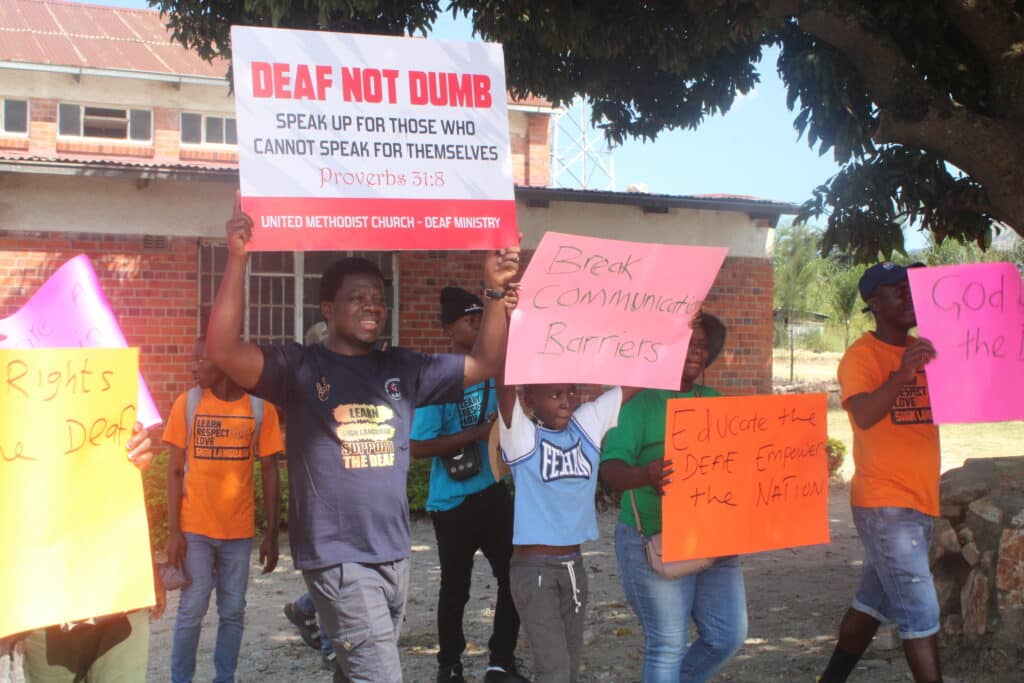
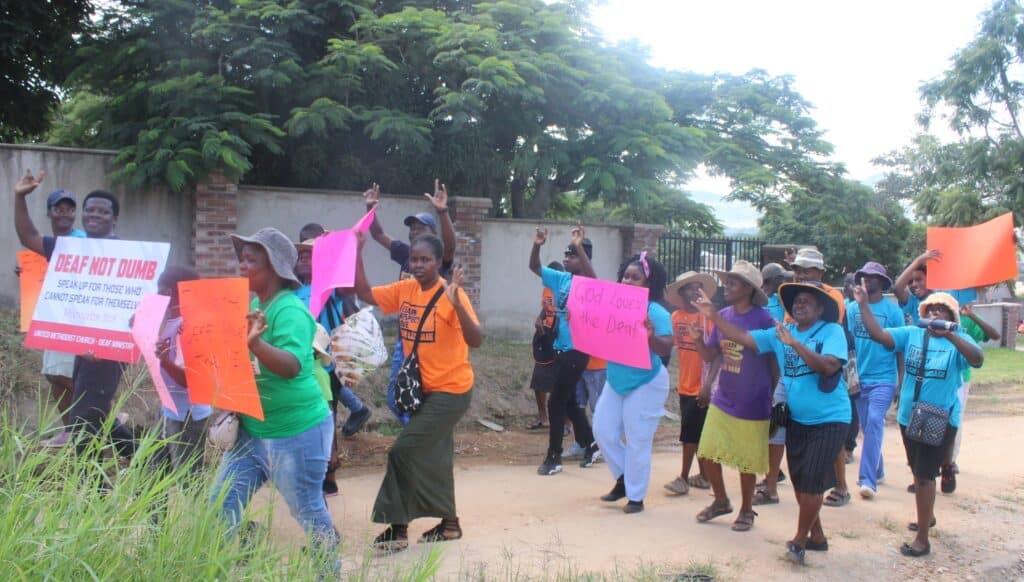
MUTARE, Zimbabwe – Mutare became a city of silent yet powerful voices during Deaf Ministry Week, as a march unfolded from Meikles Park to Sakubva Hilltop United Methodist Church.
The event was not just a march; it was a plea, a declaration and a celebration all at once.
Nearly 70 members of the Deaf and hard-of-hearing community, often overlooked and marginalized, took to the streets to demand recognition and inclusion.
Global Ministries funded the Dec. 6, 2025, march with a grant for $1,531. The witness was led by Pastor Collins Prempeh, the first Global Ministries’ regional missionary for Deaf and hard-of-hearing ministries in the Zimbabwe East Annual Conference, who is Deaf, alongside the Rev. Sophirina Sign, who was conference connectional ministries director before becoming a district superintendent in January.
Together, they carried a vision that had long been on Pastor Prempeh’s heart. They envisioned a society where the Deaf and hard of hearing are not excluded from schools, workplaces, churches or public spaces, but are embraced as equal members of the human family.
“We need equality because we are equal before the eyes of the Lord,” Prempeh said. “God created man in his own image, meaning we are all equal in the image of God.”
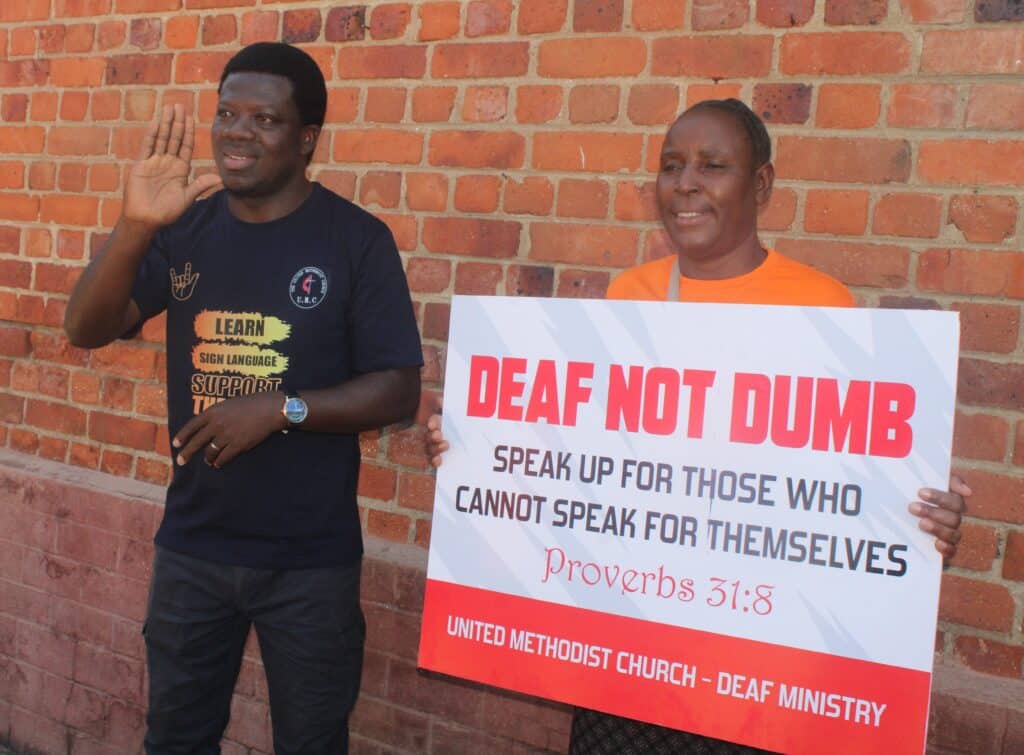
He quoted Proverbs 31:8: “Speak up for those who cannot speak for themselves, for the rights of all who are destitute.”
His call was not abstract but rooted in the reality of the struggles that Deaf and hard-of-hearing people face daily to be heard, understood, and respected.
He urged society to do more. “Learn sign language — not as a token gesture, but as a bridge of communication and compassion.”
The Rev. Sign applauded the march for raising awareness about the challenges faced by the Deaf community. She reminded the crowd that Deaf and hard-of-hearing people can be educated, employed and self-sufficient like anyone else.
“Being hard-of-hearing does not mean they should be shunned,” she said. “They need equal opportunities, to be heard in society.”
Gedion Mawoneke, a 38-year-old father of two, marched with his wife Barbra and children. The Deaf couple have built a family filled with love through good communication. Yet he spoke of the pain of being excluded in public spaces.
“The outside world has never taken an initiative to learn sign language,” he said. “In some gatherings, a lack of interpreter made it difficult for us to effectively communicate with others. We are left in the dark.”
His 11-year-old son, Obrain Ferro, joined the march together with sister Lisa, 5, to support their parents.
“When my father returns home late at night from work, my mother is sometimes unable to hear him, so he has to sleep outside or at our neighbor’s house. It pains me,” Obrain said.
Caroline Machini, who is Deaf and a supervisor at Nzeve Deaf Centre, highlighted another dimension of the struggle for the Deaf and hard-of-hearing: the vulnerability of women to abuse and gender-based violence. “Deaf women face a lot of challenges, such as being at risk of rape, abuse and other kinds of violence,” she said.
“Reporting such crimes is often impossible because of communication barriers. Victims cannot fully explain themselves, and perpetrators exploit this silence,” she said.
Machini’s testimony underscored the urgency of raising awareness to improve inclusion, protection and justice.
Marian Marange, 15, shared her struggles. “I am Deaf, but my mother is not. When I want her to help me with homework, she will be unable to because of (the) communication barrier. This is so frustrating,” she said.
“When I am left alone at home and unable to communicate with visitors, we all become frustrated,” she continued.
Spiwe Mhere, an interpreter, reminded the crowd that deafness is not inability. “The Deaf and those hearing are equal before the Lord,” she said. “Companies should not give preference to hearing people. They should remove the concept that (Deaf and hard-of-hearing) people do not know anything.
“It is important for all to learn even a few words in sign language, so that communication can happen in moments of need, especially in hospitals, police stations or churches,” she said.
The march was filled with joy as well as determination.
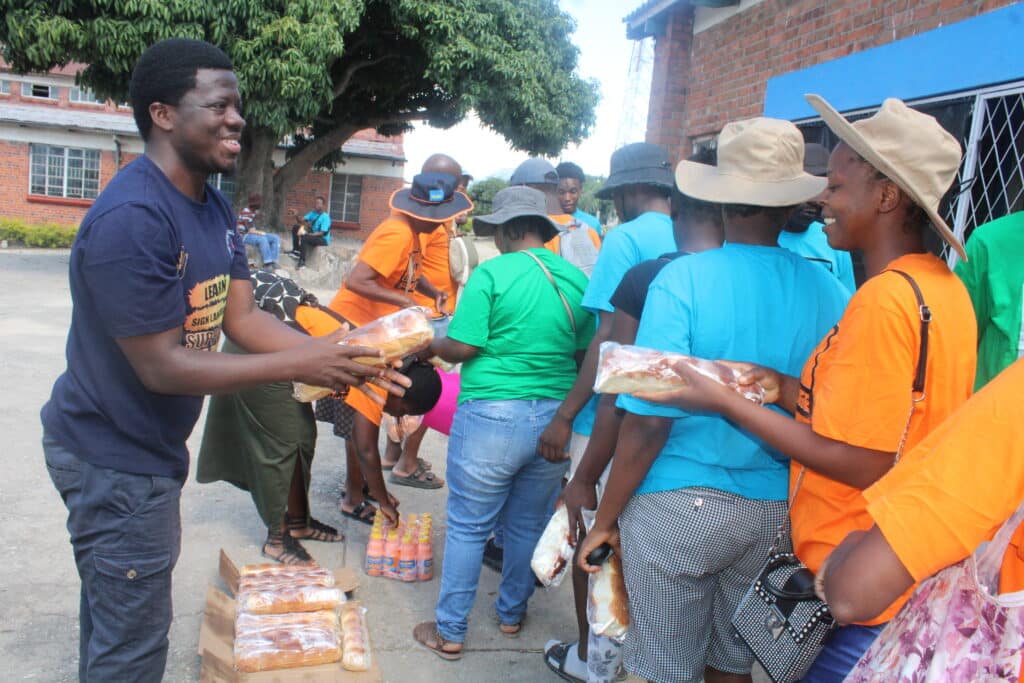
Sign noted how joyful the participants were, despite the challenges they face daily. “The police escort, efficient and cooperative, ensured safety of marchers by closing one lane for the procession,” she said. “This cooperation symbolized what inclusion can look like when institutions recognize and accommodate the needs of the Deaf community.”
The Rev. James Matsungo, Hilltop pastor in charge, thanked God for the march and emphasized that the objective was to fight against marginalization.
“Many people, even church members, see (Deaf and hard-of-hearing people) as less important,” he said, noting that many people lack interest in learning sign language. “The message was clear: we are no less important than anyone. We need love and inclusion. Our voices must be heard.”
The impact of the march was immediate, according to Prempeh. “We are overwhelmed with requests from people wanting to learn sign language. Lessons have already begun in schools, churches, and even at The United Methodist Church head office.
“Pastors are learning sign language so that sermons can reach everyone,” he said. “This is not just symbolic but also transformative. It means that (Deaf) people will no longer sit in silence during worship, excluded from the Word of God. It means that children in schools will no longer be isolated from their peers. It means that workplaces can become spaces of equal opportunity.”
The United Methodist Committee on Deaf and Hard of Hearing Ministries, part of Global Ministries, provides support and resources for developing leaders, worship and mission for and by the Deaf, hard of hearing and Deafblind. Support Global Ministries’ Global Health programs and the work of missionaries around the world.
Kudzai Chingwe is a communicator for The United Methodist Church’s Zimbabwe East Conference.