
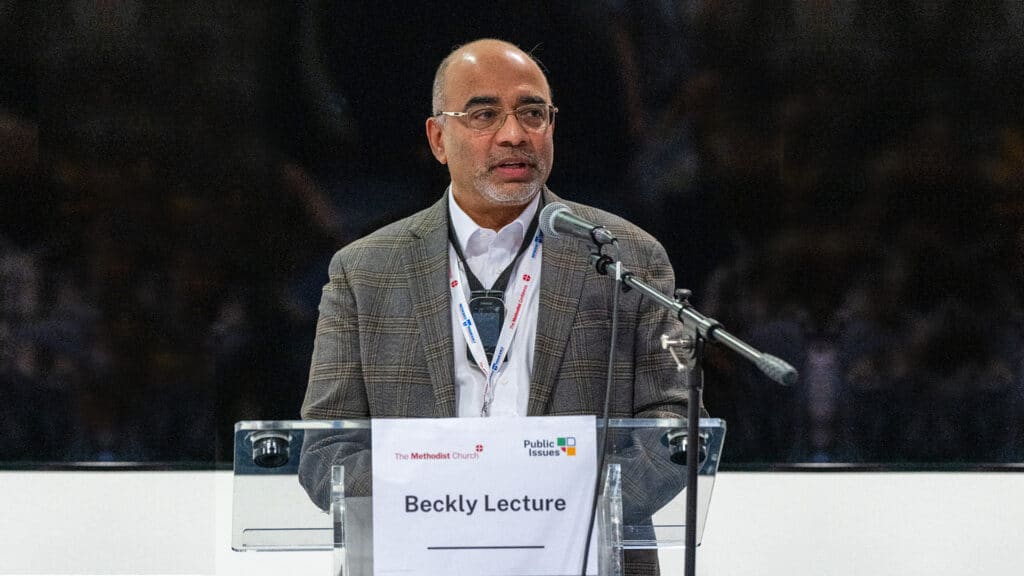
London, ENGLAND – Marking the 100th anniversary of the Beckly Social Services Lecture, Roland Fernandes, general secretary for The United Methodist Church’s general boards of Global Ministries and Higher Education and Ministry, offered a wide-ranging address on June 29 in Telford, England, that connected Methodist mission with some of the most pressing challenges facing the global church today.
Speaking on the theme “Together Towards Life in a World of Division,” Fernandes drew on the World Council of Churches’ landmark mission statement Together Towards Life and on Global Ministries’ theology of mission to explore how Christians are called to respond in a time marked by political polarization, nationalism, migration crises, conflict, and climate change. He called upon Methodists to reject exclusion, confront the legacies of colonialism, and embrace a vision of mission rooted in justice, inclusion, and peace.
Throughout the lecture, Fernandes emphasized that Christian mission begins not with cultural, national, or political agendas, but with God’s mission—Missio Dei. He argued that mission must be grounded in humility and partnership rather than superiority or domination. Acknowledging the ways Christian mission has, historically, been intertwined with colonialism and systems of oppression, he said that honest reflection on that history is essential to building authentic relationships and partnerships today.
Fernandes stressed that the future of Christian mission depends on relationships of mutuality rather than unequal patterns of giving and receiving. He said churches are called to recognize and learn from one another’s gifts, experiences, and leadership. In a world too often shaped by competition, nationalism, and power, he presented authentic partnership as a witness to God’s desire for reconciliation and shared flourishing across cultures, nations, and communities.
Fernandes spoke candidly about contemporary political rhetoric that portrays migrants, diversity initiatives, and efforts toward inclusion as threats. He rejected such narratives as inconsistent with the Gospel of Jesus Christ, stressing that marginalized communities are not problems to be managed but partners in God’s mission. Drawing on the Pentecost story in the New Testament book of Acts, he celebrated diversity as a gift from God and defended diversity, equity, and inclusion as expressions of the biblical conviction that every person bears the image of God.
Fernandes argued that true peace can only be achieved through justice, transformed relationships, and the absence of fear, not through coercion or military dominance. He highlighted ongoing partnerships in Jerusalem and on the Korean Peninsula as examples of ministry rooted in accompaniment, advocacy, and long-term commitment to reconciliation.
Fernandes also described care for creation not as a political cause but as a Christian covenant. He urged Christians to view environmental stewardship as an essential dimension of discipleship and mission, particularly because climate-related disasters disproportionately affect vulnerable communities. He pointed to initiatives such as the Yambasu Agriculture Initiative and the Global Ministries EarthKeepers program as practical expressions of this commitment.
Reflecting on the current moment, Fernandes challenged churches to reaffirm a Wesleyan vision rooted in inclusion, global connection, and social holiness. He urged Methodists on both sides of the Atlantic to see themselves as partners in a mission larger than any nation, denomination, or civilization.
Despite the challenges he described—from political polarization and forced migration to armed conflict and climate disruption—Fernandes’ message was one of hope. He pointed to the work of churches and mission partners around the world as evidence that God’s Spirit continues to bring life, healing, and reconciliation in difficult circumstances. The task of the church, he said, is not to succumb to fear or despair but to join God’s ongoing work in the world with courage, humility, and expectation.
Concluding his address, Fernandes said that Christian hope finds expression in courageous faithfulness “for such a time as this,” offering hope not as denial of the world’s divisions but as a Christian response to them. He summarized that calling as building genuine partnerships, repenting of colonial harms, celebrating diversity, accompanying marginalized communities, pursuing peace through justice, caring for creation, and publicly witnessing to the God of Life. Echoing the Council of Bishops’ vision for The United Methodist Church, he encouraged Christians to “love boldly, serve joyfully, and lead courageously” as they walk together towards life.
View a video of the full lecture below. Download a text version of the lecture.
Susan Clark is the chief communications officer for Global Ministries and Higher Education and Ministry.
The Beckly Social Services Lecture is held annually as a fringe event of the Methodist Conference in Britain and is sponsored by the Joint Public Issues Team of The Methodist Church of Britain, the Baptist Union of Great Britain, and the United Reformed Church. It is sponsored by the Beckly Trust, established in 1926 by John Henry Beckly, a lay Wesleyan Methodist. Its founding purpose is to explore the social implications of Christianity and the church’s witness on social, industrial, economic and international questions. Over the past century, Beckly speakers have brought Christian faith into conversation with public issues such as poverty, human rights, religious freedom, peace, health, migration, racial justice, postcolonial critique, political leadership and care for creation.