
Jesus said to him, “Go and do likewise.”
Luke 10: 37b
In Luke 10:25, we are introduced to an expert in the law who asks Jesus, “And who is my neighbor?” This is not a casual question. This is a boundary question. It is the kind of question that people ask when they want to know how far our responsibility should go.
Jesus of Nazareth answered this legal question with the parable of the Good Samaritan helping a Jewish person. That relationship by itself is charged with tension, division, and hierarchical human worthiness, heavily based on religious beliefs and political norms that put the “chosen” people above the rest of society. So, by crafting and telling this parable in the public square, Jesus is already confronting the status quo.
Religious leaders pass by a man who was beaten and left half dead. Both know the law, both self-proclaim to be known by and to know who God is, yet they saw the man recently robbed and moved on with their lives.
Then a Samaritan, an outsider, a foreigner, someone despised in his social and religious context, unlike the first two, stops. He binds wounds. He assumes risk. He crosses boundaries and social borders that others are protecting.
Today, there are more than 13 million undocumented immigrants in the U.S. who, for decades, have embodied the Good Samaritan’s actions; they heal wounds, feed the nation, take care of the elderly, raise children, lead with innovation, and contribute in multiple ways to society. Yet they are still despised by a government with a system of law enforcement that literally kidnaps, beats, and kills immigrants in detention centers and in the streets. The question becomes, “How are you responding?”
The Samaritan sees vulnerability and responds with a courage that is concrete, costly, and public. That is how we should respond to the violation of today’s constitutional rights. Regardless of who sits in the Oval Office, historically, anti-immigrant policies depend on narrowing the circle of concern. Who counts? Who belongs? Who deserves protection, work, safety, and dignity?
Our faith in Christ must confront the structures that produces wounded bodies. When policies separate families, criminalize asylum seekers, detain children, or dehumanize migrants through rhetoric, the followers of Jesus must step up. They go and speak up before their representatives and reject efforts to dehumanize the immigrant community. We need changes that protect immigrants and human rights; put pressure on Immigration and Customs Enforcement (ICE) and Customs and Border Protection (CBP) to stay out of our communities; and help to establish an asylum system that centers the sacredness of the sojourners’ lives while tearing down the militarization of the border.
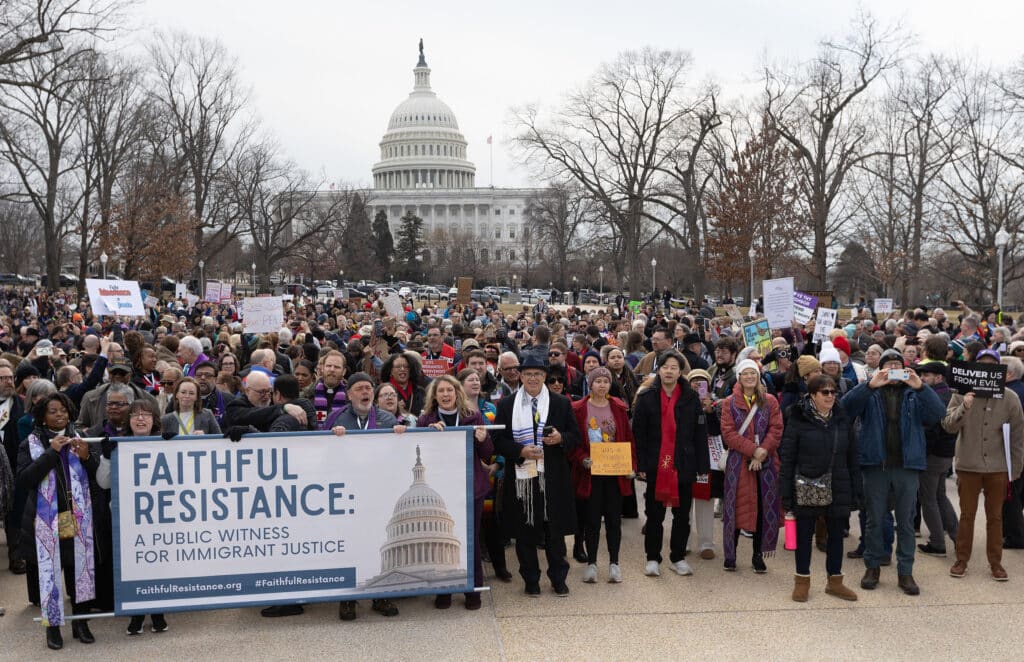
This photo of the Faithful Resistance witness, which took place at the Capitol on Feb. 25, shows one of the courageous actions (protests, making appointments with legislators, pressing for law changes) that people can do with their neighbors to stand up and speak out. That is the core of the message; our faith in Christ asks us to be courageous in moments like this. At ILJ Network, we are both motivating the church and motivated by the church and to take risks with courage to confront this kind of violent and dehumanizing immigration law enforcement.
If we continue to pass by the wounded because the law allows it, we resemble the priest and the Levite more than we might like to admit. This parable calls us to action. “And who is my neighbor?” That question becomes less about drawing lines and more about crossing them and embodying civil disobedience. Do as Jesus asks; go and do likewise.
Prayer
It is my prayer, friends, that during this Lent and beyond, may we live out the resistance of immigration law enforcement in the U.S. with concrete actions of courage that declare that God’s love, God’s justice, and God’s peace are for all. In the name of the Holy Migrant, Jesus Christ, I pray. Amen.
Caption: ILJ Network co-executive directors Alba Jaramillo (far right) and Melissa Bowe (second from left), and two staff members from Just Neighbors, ILJ affiliate, Rural Programs office manager Heather Gomez; Senior staff attorney Julia Birk. (Photo: Courtesy of ILJN)
The Rev. Carlos Reyes Rodríguez is an ordained deacon of The United Methodist Church in the Peninsula Delaware Annual Conference, serving as the Community Engagement and Operations Manager with Immigration Law and Justice Network (ILJN). ILJ Network supports 16 locally operated sites that collectively serve nearly 7,000 low-income immigrants, refugees, and asylum-seekers each year.