
There may be churches with 20 or 30 people in the pews, and that may not increase on Sunday, but your Monday through Sunday can increase. We’ve seen our Monday through Sunday increase to the thousands, which is really what the church desired.
Rev. Richard Williams,
Metropolitan United Methodist Church,
Montgomery, Alabama
ATLANTA – Metropolitan United Methodist Church in Montgomery, Alabama, was founded in 1927 as a predominantly African American congregation. Its history includes the 1939 Methodist merger and becoming part of the Central Jurisdiction, a space where Black congregations were separated from the white majority conferences and organized in their own administrative conference.
In 1968, with another denominational merger, the Central Jurisdiction was dissolved, but Metropolitan lost its denominational representation for a short time because the old was gone, but the new was not yet settled. During that time, the original church property was taken by eminent domain to make way for a new interstate highway. With what they had, the congregation bought new property – a house where they worshiped in the living and dining rooms. Eventually, two brothers constructed a sanctuary attached to the house. But somehow there was never space for a proper church office.
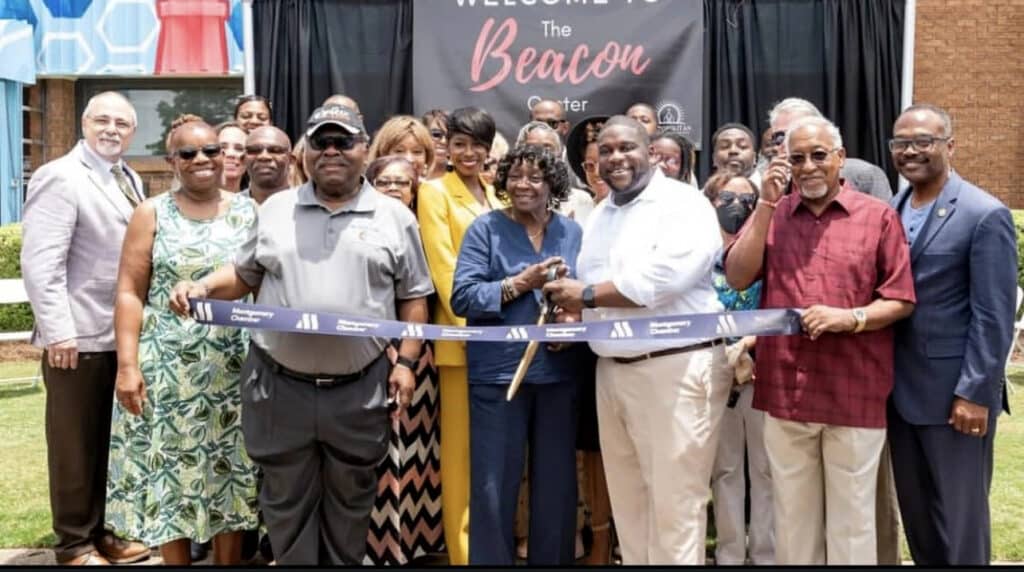
In 2021, Metropolitan UMC developed a new property called the Beacon Center, a mission hub that hosts multiple partners and a variety of services to the community that the church’s lead pastor, the Rev. Richard Williams, describes as “8,700 sq. feet of help” in the community.
Today, with a Community Developers Program (CDP) grant from Global Ministries, the congregation is entering a new phase of ministry that includes a plan for low-income housing and community development.
“Initially we were just going to throw up some houses and start rehabbing other houses,” explained Williams. “But we understood that we needed to be anchored in the work. That’s one of the things I am grateful for in the CDP program. We have years to do this. It’s not an overnight kind of space.”
In Difficult Times, a New Start
The idea for the Metropolitan UMC’s Beacon Center took root when a COVID-19 Response grant from Global Ministries Multiethnic Ministries program opened some doors. “We started responding to the needs in the community,” Williams said.
In 2019, the congregation welcomed Pastor Williams, one of the youngest pastors it has had in recent history. Originally, they concentrated on how to ramp up online worship and connection among church members. But then, after their service was up and streaming, Williams looked around and said: “Well, what else are we going to do?”
Williams describes the Beacon Center, which he serves as executive director, as a response to listening to the members inside the church and to the community. “The local church, in our tradition, includes the community around it as well,” he noted. Williams and church members began listening…to people at the local gas station, at the laundry mat down the street. He took a few members to the local school to find out what the school needed.
“We had a food pantry when I initially arrived that was serving five people a month. This special cart in the pantry of the kitchen of the church was for whomever called, and we got about five calls a month.” A church member taught him how to pack his first pantry bag.
That set-up did not seem to bring in enough people, though they knew there were many more who needed food. The church opened a food pantry in the school down the street. They soon were serving 100 people a month.
“By the height of the COVID-19 epidemic,” Williams noted, “we became the Federal Food Box location for the entire county. We were serving 5,000 a week, with 6 drop-off locations, with lines so long they were blocking up that interstate. Moving from five served to 100 to 5,000, there was really a need for us to have a building!”
They found a medical office building close to their property and before long, they convinced the owner, Dr. Albert Lester, to sell for a very good price. Finally, the church had a decent office from which to plan.
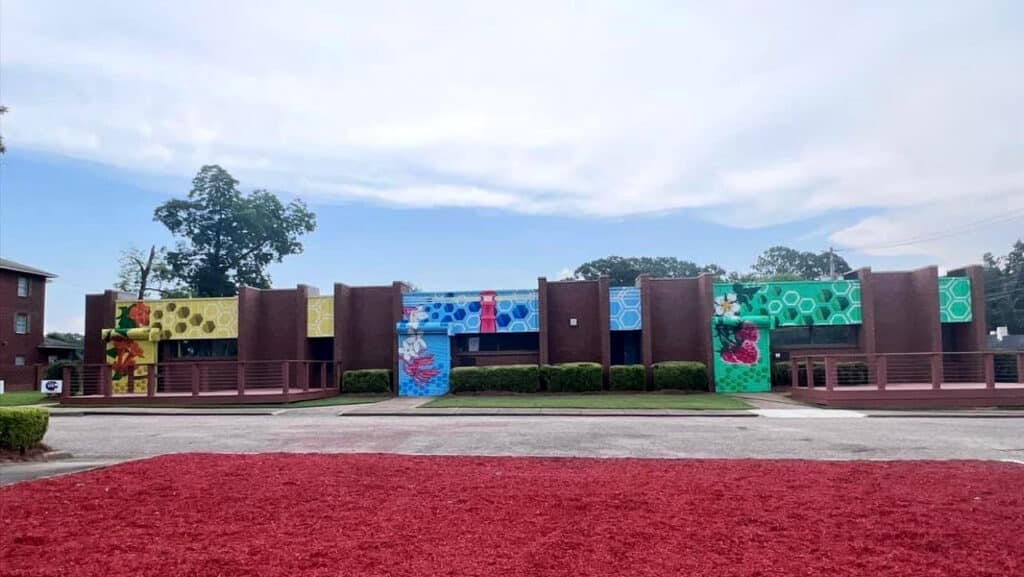
They bought the building in 2021 and moved in three months later, during remodeling. “We learned a lot in that time,” Williams continued, “we learned about each other, and most important, we learned our mission.”
Today, the Beacon hosts about 37 different programs, from court system work with bond reduction and alternate sentencing, to workforce development, health literacy and education, and HIV testing. People can find mental health services with a therapist onsite. Also available are healthy living coaching, counseling, and art and trauma support. With so many services in one place, the Beacon Center is a nonprofit incubator.
And the food pantry? It now serves 9,000 households annually.
The Beacon Center’s one-line motto is: “We exist to remove barriers for our neighbors so they can have a better life.”
Community Building Takes a Community
The initial COVID grant jump started not only the church’s food and nutrition work, it also introduced some opportunities for internships – and talent development. According to Williams, it allowed Metropolitan UMC to be seen in a different way. “Trying to do ministry in a new way, when you are an established church and space, is very hard. It’s hard for people to see the ministry in a different light. We often judge a church by how many people are on staff and how many people sit in the pews, rather than its impact to the neighborhood and its relationship to living out the call that we have said we believe in.”
Metropolitan UMC averages from 13-17 partner organizations working with the Beacon Center. It varies depending on grant availability and other factors. Last year, their HIV portfolio lost a federal grant, cut by the Department of Government Efficiency (DOGE) for a total loss of $1.2 million over three years. “Yea, we got ‘Doged,’” Williams said, “but we are still doing that work.”
Their new venture into affordable housing also includes a plan for comprehensive support, with food security and access to health services and mental health services. The first phase of the CDP grant will give Metropolitan UMC time to develop as a Community Development team, with the pastor, church members, and community members all working together with space to grow and develop.
“I believe this will create a greater momentum for the housing project that we know we want to build in this space,” said Williams.
Christie R. House is a consultant writer and editor for Global Ministries and UMCOR.